Skip to the content

BLEU CHIP LTD

Specialised cleaning · 50C Ealing Road, Wembley HA0 4TQ
Specialised cleaning at 50C Ealing Road, read as premises against operation

  • 81222 Specialised cleaning activities Operations
  • 68201 Renting and operating of Housing Association real estate Let property
  • 45112 Sale of used cars and light motor vehicles Vehicles
  • 45200 Maintenance and repair of motor vehicles Vehicles
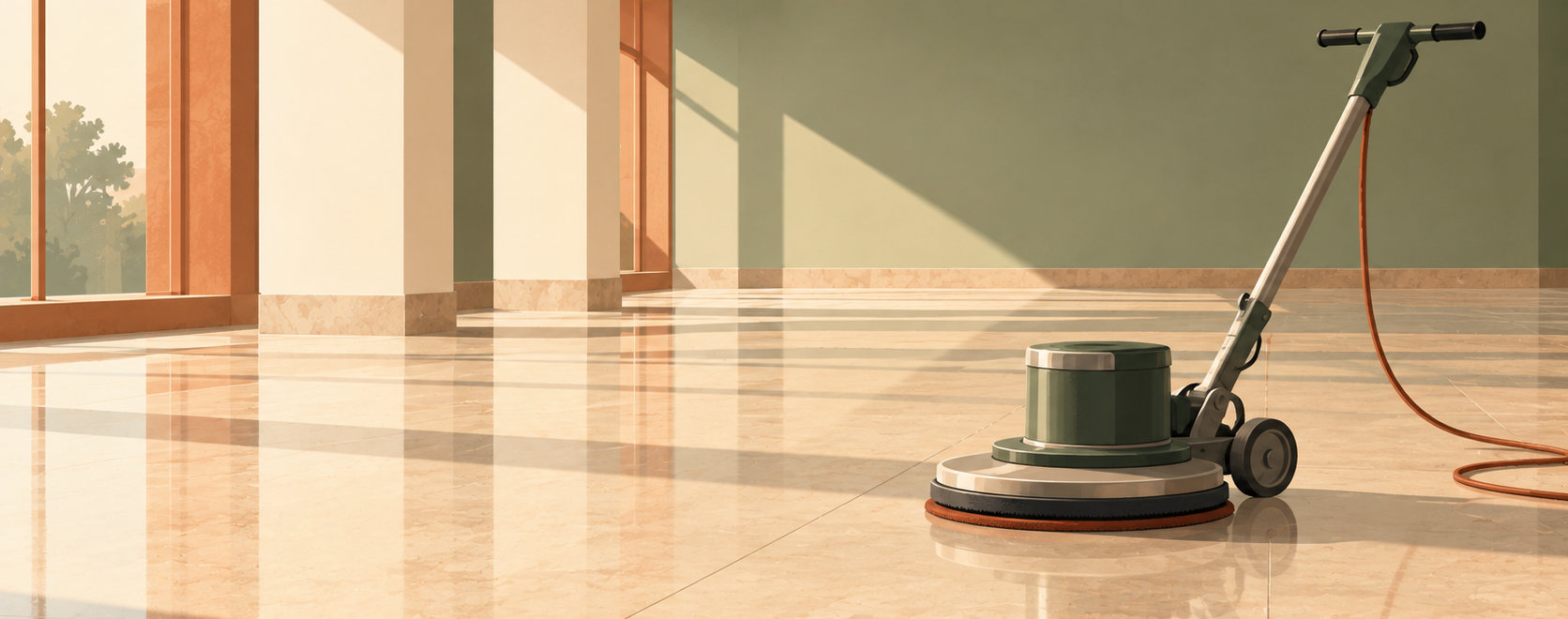
Flat vector drawing of an empty polished stone floor running away in perspective, daylight falling across it in bands from a glazed wall on the left, a plain sage wall at the far end, and one rotary floor machine standing on the tiles at the right with its cable trailing off behind it.

Chapters 1 to 4 · premises down the side, operations across the top

Work is booked two ways at once: by the premises it goes into, and by the operation carried out in it. Two of the sixteen pairings do not apply, and say so rather than carry a tick.

Position in the four by four matrix Four rows of four cells. The rows are numbered one to four for the premises types and the columns are headed DC, FC, PW and VT for the four operations. The row of the chapter currently open is outlined in clay. The cell where row two meets VT is drawn empty and dashed: a communal area is never void, and that cell says so instead of claiming the pairing. DC FC PW VT 1 2 3 4
  1. Flats between tenancies
  2. Stairs, bin stores, chutes
  3. Workshop bays and apron
  4. Shop floor and stockroom

1 · Flats between tenancies

Deep clean

Ceiling line down to the threshold: fittings, door tops, cupboard carcasses, sanitary ware, floor.

Floor care

Vinyl scrubbed and rinsed with the window latched, carpet extracted, drying time on the sheet.

Post-works

Follows the trades out: plaster off frames and glass, adhesive off vinyl, dust from the vents.

Void turnaround

Kitchen and bathroom first, they take longest; then bedrooms, hall, floor, meter cupboard.

2 · Stairs, bin stores, chutes

Deep clean

Behind the fixed things: under the nosings, the back of each riser, hopper frames, brackets.

Floor care

Matting lifted and the well beneath it cleaned first, or it puts the grit straight back.

Post-works

Dust that travelled from a riser or a lift: sills, closer tops, diffusers. Protection up last.

Void turnaround

A communal area is never void, so the cell has no ordinary meaning: its equivalent is a block handover.

3 · Workshop bays and apron

Deep clean

Degreasing before cleaning. Degreaser dwells on oil driven into the surface, is agitated, picked up wet.

Floor care

Swarf swept before anything wet appears; ramp surrounds and pit edges by hand, apron in sections.

Post-works

After a bay is re-laid: cutting dust off every horizontal, shutter guides included.

Void turnaround

A unit handed back at lease end. Oil staining, shutter condition and interceptor written down first.

4 · Shop floor and stockroom

Deep clean

After close. Floor cleared in sections, chiller gaskets and plinths by hand.

Floor care

Parade tiles are usually sealed: sweep, neutral detergent, rinse, dry. No stripping unless the seal failed.

Post-works

A shop fit leaves silicone and sticker residue on the ceiling tiles. Glass last, back-of-house after the front.

Void turnaround

Cleaned to the schedule of condition and no further. Making good fixings is not this work.

5 · Two rooms in section, because the question is where water may go

Both are cleaned wet, and both arrive on the order as floor care. That is the end of it.

A bin store drawn in section A room cut through from side to side. A chute drops through the ceiling into a hopper on the far wall. The slab falls from the doorway on the left towards a grated gully at the foot of the far wall, and a trapped bend is drawn in the ground below the gully. A low kerb across the doorway keeps the fall inside the room. kerb hopper gully trap
Bin store. The slab falls away from the door to a trapped gully, and a kerb keeps the water off the landing.
A workshop bay drawn in section The same room size cut through from side to side. The slab is level. A low drive-on ramp stands near the left wall and an inspection pit is cut down through the middle of the slab, its two edges marked. A gully at the right runs down into a two-chamber interceptor drawn in the ground, with a dip pipe hanging into the first chamber and a liquid line across both. ramp pit edge interceptor
Workshop bay. The floor is level, the pit edge a hand job, the interceptor looked at before a hose is uncoiled.

So one column means a wet pick-up into a tank here and a rinse to the gully there. The room decides, not the column.

6 · The four operations as the register carries them

The columns are not interchangeable: what finishes one does not finish another, and the column booked decides which sheet gets signed.

CodeOperationWhat finishes itWhat it is not
DCDeep cleanEverything above the floor, then the floor, and nothing walks back over itA regular clean taken slowly
FCFloor careThe floor dry, drying time on the sheetStripping, unless the seal has failed
PWPost-worksProtection lifted last of all, glass after itMaking good what the trades left
VTVoid turnaroundKeys back on a signed receiptAn inventory or a schedule of condition

7 · One bay, six passes, and the strip no rotary reaches

One bay buffered in six overlapping passes A plan of a rectangular bay with a doorway in the top left corner. Six curved bands have been swept across the floor, each band wider than the distance to the one before it so that the two overlap along their length. The swept surface is lighter than the floor around it. A strip of unswept floor remains all round the perimeter, where the machine cannot reach and the work is done by hand, and the rotary head is parked at the end of the last pass by the doorway with its pad lifted clear. overlap doorway by hand
Six passes across one bay, forty-six units wide on a thirty-four unit spacing, so each lap covers about a quarter of the one before it. Anything narrower leaves a stripe that shows only as the floor dries, by which time the machine is back on the van. The strip round the perimeter is what no rotary reaches, and it goes by hand.

8 · Four lines on the works order before anyone travels

The order is written before the van is loaded.

  • The row

    Flat, communal, workshop or parade unit.

  • The column

    DC, FC, PW or VT. One of them.

  • The access line

    Who holds the key and the hours the door is open.

  • The sign-off

    The sheet the finished work is signed against.

9 · What a survey settles before a machine is switched on

Substrate decides the machine, the machine decides the pad, and the pad decides the dilution — in that order, and never the other way about.

A survey is a sheet and not a conversation: substrate, existing seal, where water drains, nearest tap, nearest socket, and what stands in the room that will not move.

A sealed floor stripped when it should have been scrubbed cannot be put back the same visit. That is the whole reason the sheet exists.

10 · Pass planner: path width, overlap and metres walked

Two passes seen end on Two shallow domes standing on a floor line, each one the width of the machine's path. The right dome begins before the left one has finished, so the two cross and the shaded sliver between them is the overlap. A bracket under the floor line measures from the start of the first dome to the start of the second, which is the width that each pass actually adds. counts lap
Two passes end on. Only the unshaded part of each dome is new floor.

Area alone cannot say how many passes a room takes, so the sheet states its assumption — a square bay, side the square root of the area. A corridor goes in as its own area.

Sheet A · passes and metresguide only

As measured

square metres

millimetres, off the plate

per cent of the path width

Effective path
0.408 m
Passes
27
Walked
295.7 m

0.510 m × (100 − 20) ÷ 100 = 0.408 m per metre walked
√120 m² = 10.95 m, the side of a square bay
10.95 m ÷ 0.408 m = 26.84, rounded up to 27 passes
27 × 10.95 m = 295.7 m walked, the last a part pass

Guide only — it does not know the furniture

11 · Dilution sheet: ratio, solution and containers

The ratio comes off the works order, never off the shelf. Concentrate is measured in first and the water goes on top, so the dose is in before anyone loses count.

Solution is made for the visit, not for the week. A container left overnight is emptied and the sheet run again.

Containers are filled to a line, never the brim, and each carries the ratio and the date in that order.

Sheet B · dilutionguide only

As ordered

parts water

litres

litres

Concentrate
244 ml
Water
9.756 L
Containers
2

1 : 40 is 41 parts, one of them concentrate
10 L ÷ 41 = 0.244 L, so 244 ml of concentrate
10 L − 0.244 L = 9.756 L of water
10 L across 2 containers: 5 L each, 122 ml of it concentrate

Guide only — the ratio on the order wins

12 · The other three registered activities, and the rest of this site

Three of the four codes on the board are not cleaning: two cover vehicles, one covers renting and operating Housing Association real estate. They share the Ealing Road address, a van and a waste route, and nothing else. Separate orders, separate files, separate pages.

13 · The office at 50C Ealing Road

BLEU CHIP LTD was incorporated on 31st August 2026 in England and Wales, company number 17428787, and its registered office is 50C Ealing Road, Wembley HA0 4TQ.

Works orders and access arrangements go to contracts@bleuchip.online. Post is received at 50C; the letterbox is not a key drop, and keys move on a signed receipt. What becomes of anything sent here is under what is held.